
'There has definitely been a breakthrough in the nuclear logjam. It is good to see nuclear energy back on the rails,' says Dr Anil Kakodkar, former chairman, Atomic Energy Commission.

Amidst ongoing tensions with the ruling DMK government, Tamil Nadu Governor R N Ravi has invited Vice President Jagdeep Dhankar to inaugurate a meeting of state university Vice Chancellors in the Nilgiris district, sparking criticism from political parties, particularly the Left, who have urged a boycott. The meeting comes in the wake of the Supreme Court ruling in favor of the Tamil Nadu government regarding the appointment of Vice Chancellors, which has stripped the Governor of his previous authority as Chancellor. The Governor, however, maintains his right to convene the meeting, highlighting the ongoing power struggle between the Governor and the state government. The meeting is scheduled for April 25 and 26.
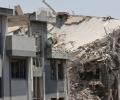
An inconclusive end to this war will pose high risk for Netanyahu of a cascading demand for a regime change in Israel, predicts Ambassador M K Bhadrakumar.
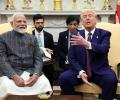
From bhikshus of Ashokan 3rd century BC and medieval Sufis to Oxfam, Omidyar and Soros now, non-State actors have any real power only when they work in conjunction with a real State, asserts Shekhar Gupta.

The feud reached its peak when Musk made explosive allegations about Trump's connection to disgraced financier Jeffrey Epstein, marking a dramatic escalation in their increasingly personal conflict.

Pyongyang on Sunday claimed it has successfully tested a hydrogen bomb meant to be loaded onto an intercontinental ballistic missile. It was Pyongyang's sixth, and most powerful, nuclear test, which was set to raise tension in the region.
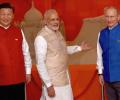
'With Pakistan's 'first use doctrine' threatening the use of nuclear weapons early in a war with India, the S-400 will shield vulnerable targets like Delhi and Mumbai, complicating Pakistan's targeting calculations.'

20 years ago this day, May 11, 1998, India conducted its second nuclear test at Pokharan in Rajasthan. In a fascinating interview on Rediff.com, K Subrahmanyam revealed how Indian PMs reacted to nuclear ambitions.
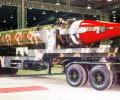
For the world and India, one of the most enduring challenges of the times is for Pakistan's nukes to be neutralised, before they are ever used by the State, their sponsored non-State actors or any rogue elements from the many terror tanzeems dotting Pakistan's unstable landscape, says Lieutenant General Kamal Davar (retd).

PM Modi and his Japanese counterpart are likely to sign several agreements, including on civil nuclear cooperation. Both leaders are also likely to discuss defence cooperation, including joint maritime exercises between Japan, India and the United States.

More than nuclear power, India stands to gain access to a wide range of dual-use goods and technologies, from which it was barred, as a result of the waiver by the 45-country Nuclear Suppliers' Group.
The IAEA is developing a concept whereby countries that establish nuclear power plants with an assurance that they will not proliferate will get an 'assurance of fuel supply' for their reactors from the agency.

India has voted against the provisions of draft resolutions that would have required it to accede to the Nuclear Non-Proliferation Treaty, saying there is "no question" of it joining the treaty as a non-nuclear weapon state.

Officials hint the visit could finally see a formal defence industrial road map being adopted by both nations.

Several nuclear power projects held up for the lack of such an insurance pool can now be expected to move forward.

'It was India's good fortune to have a Vajpayee lead the government at this crucial moment in history.' 'By taking the N-decision he saved future generations of Indians from being 'Kosovoed' or 'Iraqed',' says Colonel Anil A Athale (retd).
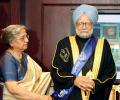
Nitin Desai, who has known Dr Singh from 1971, extends his 'deepest condolences to his wife Gurcharan Kaur and to his three talented daughters Upinder, the historian; Daman, the writer; and Amrit, the human rights activist.'

The talks could be a last-ditch diplomatic effort to avert a military strike on Iranian nuclear installations and could also help President Barack Obama make the case that he is nearing a breakthrough in the decade-long effort by the world's major powers to curb Tehran's nuclear ambitions.

We the people are left in the wind, waiting on the whims of an unengaged president and an oligarch with a nearly bottomless wallet, observes Sree Sreenivasan.

The intelligently conceptualized show does more for nationalistic pride than a dozen jingoistic series, applauds Deepa Gahlot.
Pakistan on Thursday expressed hope that the agreement between Iran and Western powers on Tehran's nuclear programme would pave the way for faster implementation of an ambitious bilateral gas pipeline project.

The partial withdrawal would mean that Iran would stop exporting enriched uranium stocks as stipulated by the 2015 agreement.

Pakistan's fourth heavy water reactor at Khushab nuclear site which allows it to build a larger number of miniaturised plutonium-based nuclear weapons now appears to be operational, a US think-tank has said.

Negotiating a sustainable compromise with Iran is not getting any easier, and this delay might not yield the desired result of bringing Tehran's nuclear programme under stringent limits, says Claude Smadja
'Why should we disclose classified information to satisfy those who doubt our Hydrogen Bomb capability?'
The Indian Diaspora has been able to carve a niche in their adopted countries as a result of their talent, perseverance and hardworking nature, asserts Rup Narayan Das.

Although the pact would focus mainly on the Pacific and the South China Sea region, any action designed to deter China with or without New Delhi's active participation is a welcome move, notes Commodore Venugopal Menon (retd).
Recently, Iran and western powers signed a deal in which it was agreed the West Asian nation would scale down its nuclear programme in exchange for a cut in economic sanctions.
Diplomatic observers and foreign policy wonks were left perplexed trying to figure out what Senator John F Kerry meant when he said India had begun "to reinvigorate its own programme there", which he described as "absurd on both sides".
India has offered to place 14 of the 22 thermal power reactors under IAEA safeguards in a phased manner between 2006-14, Dr Kakodkar told a media conference, adding the agreement would not affect the country's strategic programme in any respect.

Netflix has announced a thrilling line-up for 2025.
'We have not done anything different than these six nuclear powers of today did, to attain nuclear capabilities. Why then we are being discriminated, when we bought all the supplies from these western companies and followed the same strategy to achieve the same nuclear capability like these six nuclear nations,' he asked during an interview with The News.
Some people, who talk about the high expenses of nuclear programme, do not know the importance of nuclear capability, Dr Samar Mubarakmand, Member Science and Technology, Planning Commission of Pakistan, said.

The United States, which spends billions monitoring adversaries like Al Qaeda, North Korea and Iran, pays an equal amount of attention on ally Pakistan and has ramped up surveillance of its nuclear arms, according to a report.

'Only when India's adversaries are convinced that India has both the necessary political and military will and the hardware to respond to a nuclear strike with punitive retaliation that will inflict unacceptable loss of human life and unprecedented material damage, will they be deterred,' says Brigadier Gurmeet Kanwal (retd).

A leading US daily describing nuclear-armed Pakistan as "unquestionably the biggest concern" to stability in South Asia.
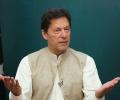
Pakistan's nuclear arsenal is 'simply a deterrent' to protect the country and there will no longer be any need for it once the Kashmir issue is resolved, Prime Minister Imran Khan has said as he asserted that if the Americans have the resolve and the will, the issue can be sorted out.

The government has cleared the indigenous construction of seven stealth frigates and six nuclear-powered submarines to bolster naval power.

After a year's delay due to COVID-19, the 19th Asian Games officially opens in Hangzhou on Saturday with hosts China eager to lift a country mired in economic gloom.
For a country whose national capital has routine blackouts in its poshest colonies, not to mention the rest of the country, the debate on the advisability of nuclear power is bizarre, says Sanjaya Baru
